


The question burning through tech circles isn’t whether AI will change Android development—it’s already happening. Every time a developer accepts a GitHub Copilot suggestion or uses ChatGPT to debug a tricky Kotlin error, they’re witnessing the transformation firsthand.
The real debate centres on whether AI will replace developers entirely, or if we’re heading towards something far more nuanced.
Android development has evolved dramatically since the platform’s 2008 launch. We’ve progressed from simple Java apps to sophisticated Kotlin-based applications leveraging Jetpack Compose, machine learning models, and complex architectural patterns. Now, AI co-pilots are entering the scene as powerful assistants, capable of generating boilerplate code, suggesting optimisations, and even architecting basic features.
Recent insights suggest that by 2030, AI tools will fundamentally reshape how developers work, but the picture is more complex than simple replacement. The technology excels at repetitive tasks—writing data models, creating standard UI components, or generating unit tests—yet struggles with the creative problem-solving that defines exceptional Android development.
What we’re witnessing isn’t the extinction of Android developers, but their evolution into a new hybrid role where human creativity and AI efficiency combine to build better apps, faster.
Understanding AI Co-Pilots in Software Development
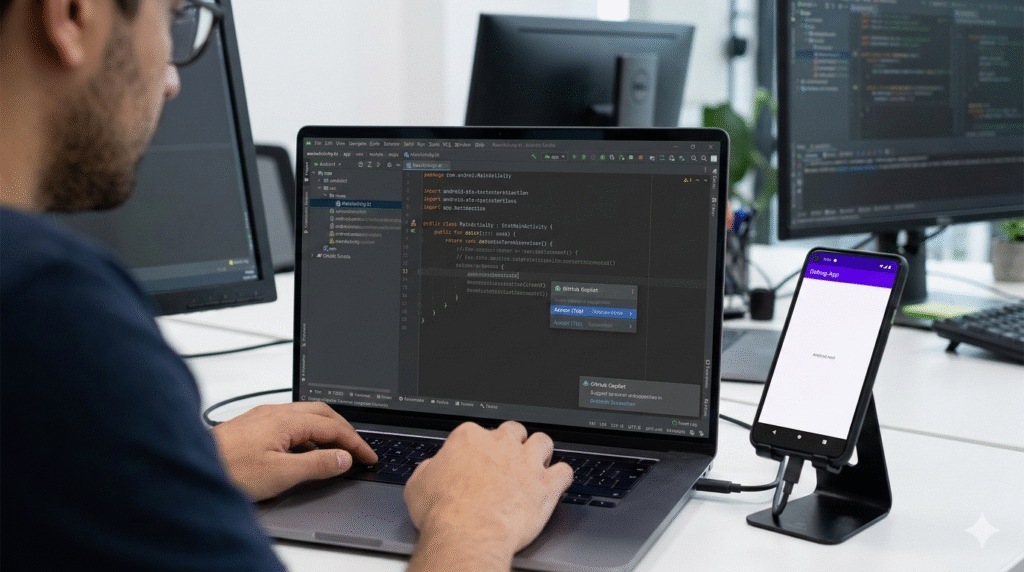
The debate around whether AI will replace developers entirely misses a crucial reality happening right now in Android development studios worldwide. AI hasn’t arrived as a replacement—it’s embedded itself as a collaborator. GitHub Copilot suggests entire function implementations whilst developers type. Android Studio’s AI features autocomplete complex layouts before the semicolon hits the keyboard.
These tools aren’t autonomous coders. They’re pattern recognition engines trained on billions of lines of code, predicting what you’ll likely write next based on context. The difference? A junior developer might suggest three solutions. An AI co-pilot presents thirty, instantly. However, distinguishing brilliant from buggy still requires human judgement—research shows AI-generated code requires oversight to avoid security vulnerabilities and architectural missteps.
What’s genuinely transformative isn’t the code completion. It’s the cognitive load reduction. Developers now offload boilerplate generation, focusing mental energy on architecture decisions and user experience nuances. The question shifts from “Will AI will replace developers?” to something more interesting: What happens when every Android developer has an AI assistant that remembers every Stack Overflow answer ever written?
Predictive Coding: Revolution or Evolution?
Predictive coding represents the most visible face of AI’s entry into Android development, yet understanding its true nature reveals why fears that AI will replace software engineers fundamentally misunderstand the technology. When GitHub Copilot suggests your next line of Kotlin before you’ve finished typing, that’s pattern recognition—not strategic thinking.
The revolution lies in speed, not replacement. Developers using predictive coding tools report 30-40% faster completion of routine tasks, freeing mental bandwidth for architecture decisions that AI cannot make. These tools excel at autocompleting boilerplate code, suggesting API implementations, and catching syntax errors before compilation. However, they struggle with context-specific business logic, security considerations requiring judgment, and the architectural decisions that define quality Android applications.
What’s actually happening is evolution: the developer’s role shifts from typing repetitive patterns to orchestrating complex systems. Rather than replacing engineers, predictive coding eliminates the mundane, allowing developers to focus on problems requiring human creativity—designing user experiences, optimising performance for specific hardware constraints, and making trade-offs between competing technical approaches. The real mistake organisations make is viewing AI as a developer substitute rather than a productivity amplifier that still requires expert oversight.
Comparison: Human Developers vs AI Tools
The question of whether AI will replace programmers fundamentally misunderstands how these technologies currently complement rather than compete with human capabilities. While AI tools excel at pattern recognition and repetitive coding tasks, human developers maintain decisive advantages in architectural decisions, contextual understanding, and creative problem-solving that define successful Android applications.
Human strengths centre on understanding business requirements, making strategic technology choices, and navigating the nuanced trade-offs between performance, maintainability, and user experience. Android developers synthesise stakeholder needs, anticipate edge cases, and design systems that evolve with changing requirements—cognitive tasks that current AI tools struggle to replicate.
AI advantages lie in accelerating routine implementation, suggesting boilerplate code patterns, and catching common errors before compilation. These tools reduce cognitive load on mundane tasks, allowing developers to focus mental energy on higher-level challenges.
The practical reality emerging in 2024 reveals a complementary relationship: developers who leverage AI coding assistants report productivity gains whilst maintaining full control over architectural decisions. This collaboration model suggests an evolution rather than replacement, where technical expertise remains irreplaceable but the tools developers wield grow increasingly powerful.
Pros of Human Developers in Android Development
While Android developers AI tools excel at code generation, human developers possess irreplaceable advantages that define the craft’s future. Creative problem-solving remains distinctly human—the ability to reconceptualise challenges, question assumptions, and devise architectures that AI cannot envision without explicit instruction.
Contextual understanding separates competent code from exceptional applications. Human developers grasp business objectives, user psychology, and brand identity in ways that inform thousands of micro-decisions throughout development. They navigate ambiguous requirements, prioritise competing demands, and make strategic trade-offs that automated systems struggle to evaluate.
Domain expertise proves critical when building complex Android applications. Developers bring industry-specific knowledge—whether healthcare regulations, financial security protocols, or gaming mechanics—that shapes appropriate solutions. This specialised understanding, combined with career-long learning, enables professionals to anticipate edge cases and compliance requirements that AI tools cannot independently identify.
Perhaps most crucially, human developers excel at stakeholder communication and leadership. They translate technical constraints into business language, mentor junior team members, and drive architectural decisions through collaboration. These interpersonal capabilities—empathy, negotiation, teaching—remain firmly outside AI’s current capabilities, ensuring developers maintain central roles in shaping Android’s evolution.
Strengths of AI Tools in Software Engineering
AI coding assistants have revolutionised repetitive development tasks, delivering measurable productivity gains that complement human expertise. These tools excel at pattern recognition, generating boilerplate code at remarkable speed—what might take developers hours to scaffold now completes in seconds.
The real strength lies in handling mundane tasks: converting design mockups to XML layouts, suggesting API integrations, and catching syntax errors before compilation. Research indicates developers using AI assistants complete routine coding tasks 40-50% faster, freeing mental bandwidth for architectural decisions and creative problem-solving.
However, these tools remain fundamentally reactive rather than strategic. They process existing patterns brilliantly but struggle with novel challenges requiring domain expertise or business context. An AI might generate a perfectly formatted Room database schema, yet fail to recognise when a NoSQL approach better serves the use case—a distinction experienced developers make instinctively.
Future Predictions: Will AI Replace Android Developers?
The future of coding 2030 points towards evolution, not extinction. Industry analysts predict AI will handle roughly 60% of boilerplate code generation by decade’s end, yet demand for Android developers continues growing as applications become more sophisticated.
AI tools will reshape roles rather than eliminate them. Tomorrow’s Android developers will spend less time writing repetitive CRUD operations and more time architecting user experiences, optimizing performance, and solving complex integration challenges that require contextual understanding.
The critical distinction lies in problem complexity. AI excels at pattern recognition within defined parameters—generating standard login flows or database queries. However, applications requiring cross-platform synchronization, custom hardware integration, or nuanced user experience design still demand human judgement and creativity that current AI cannot replicate.
By 2030, the Android development landscape will likely feature AI as a mandatory tool in every developer’s arsenal—similar to how IDEs replaced text editors without replacing programmers. The developers who thrive will be those who master AI collaboration, using these tools to amplify their capabilities rather than viewing them as competition.
Adaptation and Integration: The New Developer Skillset
Software engineering AI demands a hybrid skillset where traditional coding expertise merges with AI orchestration abilities. Modern Android developers who thrive alongside automation tools focus on prompt engineering, model evaluation, and strategic tool selection rather than pure syntax mastery. The developer who reviews AI-generated code critically—spotting security vulnerabilities, performance bottlenecks, and architectural flaws—becomes more valuable than one who simply writes boilerplate faster.
Successful adaptation requires cultivating domain expertise that machines cannot replicate: understanding user psychology, navigating business constraints, and making architectural decisions with long-term consequences. Industry analysis suggests developers who position themselves as “AI-augmented specialists” will command premium rates, whilst those resisting tool adoption risk obsolescence. The integration path forward involves treating AI as a junior pair programmer—capable yet requiring supervision, guidance, and human judgement for production-ready results.
Limitations and Considerations
Despite the rapid advancement of AI developers 2030, critical constraints remain. Current AI tools struggle with complex architectural decisions, particularly when balancing performance, security, and scalability trade-offs that require deep contextual understanding. Why Replacing Developers with AI was the biggest mistake ever? highlights that AI lacks genuine comprehension of business logic and user intent.
Technical limitations include difficulty with legacy code maintenance, where undocumented systems require human intuition to decipher. AI also falters in creative problem-solving scenarios that demand unconventional approaches outside training data patterns. Edge cases, nuanced debugging, and ethical considerations in implementation decisions remain firmly in human territory—machines can suggest solutions but cannot weigh moral implications or brand reputation impacts that developers must consider daily.
Key Takeaways
Android developers aren’t facing obsolescence—they’re experiencing a role transformation. By 2030, AI will function as an AI co-pilot rather than a replacement, handling repetitive tasks whilst developers focus on architectural decisions and user experience innovation.
The fundamental shift centres on collaboration over competition. Developers who embrace AI tools for code generation, testing automation, and debugging will amplify their productivity significantly. Those who resist adaptation may struggle, but the profession itself remains secure because AI lacks the contextual understanding and business acumen essential for complex application development.
Three critical realities define the future landscape: AI excels at pattern-based tasks but falters with novel problem-solving; human oversight remains mandatory for quality assurance and ethical considerations; and the developer role evolves towards strategic thinking and AI orchestration rather than pure coding execution. Success belongs to professionals who view AI as a productivity multiplier, not a threat to their craft.
Frequently Asked Questions
Will AI completely automate Android app development?
No. AI excels at predictive coding and automating repetitive tasks, but it cannot replace the architectural decisions, user experience design, and business logic that experienced Android developers provide. By 2030, AI will augment rather than replace developers, handling routine code generation whilst humans focus on strategic implementation.
What skills should Android developers learn to stay relevant?
Focus on AI tool integration, architectural design, and cross-functional collaboration. Understanding how to leverage AI assistants for efficiency whilst maintaining code quality will distinguish top-tier developers from those who struggle to adapt.
Is AI going to replace Android developers?
No—AI will augment, not replace, Android developers. The question “Will AI will replace software engineers 2030?” misunderstands AI’s actual capabilities. Whilst AI tools handle code generation and debugging tasks efficiently, they lack the architectural vision needed for complex Android applications.
Industry analysis confirms that AI functions best as a productivity multiplier rather than a replacement. Developers who embrace AI tools report 30-40% faster development cycles, but they still make critical decisions about user experience design, security architecture, and system integration.
The hybrid model is emerging as standard practice. Developers now spend less time on boilerplate code and more on solving business-specific problems. AI handles the repetitive tasks—generating CRUD operations, writing unit tests, optimising layouts—whilst developers focus on innovation and strategic implementation.
Will AI Replace Android Developers by 2030? Here’s My Take
The short answer: No. The question “Will AI will replace programmers 2030?” assumes AI will reach human-level reasoning by then—a claim contradicted by current technological trajectories. In practice, AI accelerates development without eliminating the need for skilled developers. What typically happens is that automation handles repetitive tasks (boilerplate code, unit tests, basic layouts) whilst complex architectural decisions, business logic, and user experience design remain firmly in human hands.
Android development in 2030 will look collaborative, not redundant. Developers will leverage AI as a force multiplier—tools like GitHub Copilot already boost productivity by 40-55% on routine tasks, but they don’t architect scalable systems or debug edge cases. The real shift? Developers become higher-level problem solvers, spending less time on syntax and more on strategy, performance optimisation, and innovation that truly differentiates apps in competitive markets.
Is AI going to replace Android developers?
No, AI won’t replace Android developers—it will redefine what they do. The debate around “AI will replace developers reddit” often misses a crucial point: AI excels at generating code, but struggles with the architectural decisions, user experience judgement, and business context that define successful Android apps.
Why Replacing Developers with AI was the biggest mistake ever? highlights how companies attempting full AI replacement hit immediate walls—AI-generated code lacked maintainability, scalability, and alignment with actual user needs.
What AI handles well: boilerplate code, unit test generation, repetitive XML layouts, and basic debugging suggestions.
What AI can’t replace: understanding stakeholder requirements, making trade-offs between performance and features, designing intuitive navigation flows, and anticipating edge cases in production environments.
The reality is more nuanced than replacement—AI becomes a force multiplier for skilled developers, handling mundane tasks whilst humans focus on creative problem-solving and strategic thinking.
Will AI Replace Android Developers by 2030 Reddit
Reddit developers aren’t worried—they’re strategising. Threads on r/androiddev show experienced developers viewing AI as a productivity multiplier, not a job threat. The real concern? Junior developers struggling to gain foundational skills when AI handles routine tasks.
One pattern emerges consistently: developers who adapt fastest treat AI tools as extensions of their workflow. They use GitHub Copilot for boilerplate, ChatGPT for documentation, but maintain ownership of architecture decisions. The consensus? AI excels at generating code; humans excel at knowing which code to generate.
The “will AI replace full stack development” debate misses the point entirely. Stack Overflow data shows developers now spend 60% less time on syntax errors but invest that saved time in system design and user experience refinement. AI hasn’t replaced the job—it’s shifted the skillset from coding mechanics to strategic thinking. Those who resist this transition will find themselves obsolete; those who embrace it become indispensable.
Which 3 jobs will survive AI?
Android developers who think strategically will outlast the automation wave. While asking “will AI replace app developers” has become common, research shows that three developer roles remain resilient: system architects, security specialists, and platform engineers.
System architects who design application structure won’t be automated because AI can’t yet make high-level decisions about scalability, user experience trade-offs, or business constraints. Security specialists remain essential—AI-generated code often contains vulnerabilities that only experienced developers spot. Platform engineers who optimise Android performance, manage CI/CD pipelines, and troubleshoot device-specific issues possess contextual knowledge that AI tools lack.
The pattern emerges: jobs requiring strategic thinking, business context, and human judgment survive. Developers who shift from pure coding to problem-solving, who understand user needs beyond technical specifications, and who can evaluate AI-generated solutions critically will thrive through 2030 and beyond.
Is AI pushing 75% of code?
The reality is less dramatic than headlines suggest. While various tools claim to generate significant code volumes, industry analysis shows that most production code still requires substantial human refinement. AI tools typically contribute boilerplate and standard patterns rather than complex business logic.
What developers actually experience is AI handling repetitive tasks—XML layouts, standard RecyclerView adapters, basic CRUD operations. The real metric isn’t code volume; it’s decision-making authority. An AI might generate 75% of a function’s lines, but developers still architect the approach, handle edge cases, and ensure security compliance.
Understanding AI impact near future means recognizing that code generation isn’t development. Production-ready Android apps require architectural decisions, performance optimization, and UX refinement that current AI can’t autonomously deliver. The 75% figure measures output, not value—and that distinction matters when planning your career trajectory beyond 2030.
What jobs will no longer exist in 2030?
Routine coding roles are already fading, but the question “will AI will replace Android developers by 2030” misses the real shift. Rather than entire jobs disappearing, specific task clusters within development roles are being automated. Entry-level positions focused purely on copying code patterns or implementing basic CRUD operations face the steepest decline. Industry analysis suggests that roles requiring minimal decision-making will consolidate first—think junior developers who primarily translate specifications into boilerplate code without architectural input.
However, the transformation isn’t about wholesale replacement. What typically happens is job descriptions evolve: yesterday’s “Android developer” becomes tomorrow’s “Android experience architect” who orchestrates AI tools whilst maintaining quality standards. Maintenance-only positions and roles isolated from user impact show vulnerability, whilst specialists who bridge technical implementation with business outcomes remain essential. The pattern emerging shows that jobs lacking creative problem-solving or strategic thinking will merge into AI-assisted workflows rather than vanish completely.
What AI change do you think will actually happen in …
The most likely shift involves collaborative coding environments rather than wholesale replacement. When developers search “AI will replace Android developers by 2030 github” on platforms like GitHub, automated code reviews, and intelligent merge suggestions. The realistic change isn’t developers disappearing—it’s their workflow fundamentally restructuring. Expect three concrete developments: First, AI will handle routine Android framework updates and dependency management automatically. Second, natural language interfaces will let developers describe complex UI behaviours that AI then implements. Third, continuous testing and optimisation will run autonomously in the background, catching issues before human review.
However, architectural decisions, user experience design, and strategic technical choices will remain firmly human territory. The transformation centres on eliminating tedious tasks rather than eliminating developers themselves.
Where do you think AI will be by the year 2030?
The consensus across developer communities points to a dramatically expanded AI toolkit rather than developer extinction. Online forums like r/accelerate reveal what practitioners actually expect: AI handling increasingly complex tasks whilst creating entirely new specializations. The demand for AI engineers 2030 will likely shift towards oversight roles—developers who understand both traditional coding and AI system architecture.
Current patterns suggest Android development will split into two distinct paths: those who adapt AI tools into their workflow, and those who focus exclusively on AI-native application frameworks. However, the biggest mistake remains assuming AI can replace the strategic thinking developers bring. By 2030, we’ll likely see AI autocompleting entire feature implementations, yet human developers steering product direction, and user experience decisions. The practical reality? AI will handle repetitive tasks brilliantly whilst struggling with novel problems requiring business context. Android developers who position themselves as “AI-augmented specialists” rather than pure coders will find their expertise increasingly valuable.
How much is AI really going to change the near future ?
The five-year horizon brings practical augmentation rather than dramatic upheaval. Android developers can expect AI tools to handle approximately 30-40% of routine coding tasks by 2029, based on current adoption trajectories. This means faster boilerplate generation, automated testing scaffolds, and intelligent code suggestions that actually understand your project context.
The transformation centres on workflow acceleration. Tasks that currently consume two hours—setting up navigation patterns, implementing standard UI components, writing unit tests—will compress to 20-30 minutes with AI assistance. However, architectural decisions, performance optimization, and user experience design remain firmly in human hands.
Industry patterns suggest evolution rather than revolution. Developers who integrate AI tools into their daily workflow report 25-35% productivity gains, yet still spend the majority of their time on problem-solving that requires human judgment. The Android ecosystem’s complexity—managing backwards compatibility, navigating platform fragmentation, optimizing battery performance—creates challenges that current AI cannot independently resolve.
One practical scenario emerging now: junior developers leveraging AI to accelerate their learning curve whilst senior developers use the same tools to eliminate tedious maintenance work. This pattern will intensify over the next five years, reshaping team dynamics without replacing team members.
Will AI will replace developers? : r/ArtificialInteligence
The question that dominates developer forums reveals a fundamental misunderstanding of AI’s actual capabilities. Reddit’s r/ArtificialInteligence threads consistently show developers oscillating between panic and pragmatism, with the latter winning as real-world implementations reveal AI’s limitations.
The consensus emerging from these discussions is illuminating: AI tools complement rather than compete with developer expertise. When developers share their experiences, they report significant time savings on routine tasks whilst simultaneously noting AI’s inability to handle architecture decisions, stakeholder communication, or nuanced problem-solving. One developer’s observation captures the sentiment perfectly: “AI writes code; developers build systems.”
What’s particularly telling is how experienced developers frame the debate. They’ve watched previous automation waves—from IDE autocomplete to low-code platforms—and recognise similar patterns. The tools evolve, the work changes, but the need for human judgment remains constant. Android development, with its complex lifecycle management and platform-specific considerations, exemplifies why wholesale replacement remains implausible rather than merely unlikely.
How do you think Android will evolve in the future?
Android’s trajectory points toward a hybrid ecosystem where AI amplifies rather than replaces human capability. The platform will increasingly embed intelligent assistance directly into development workflows—think code completion that understands your project’s architecture, automated testing that adapts to your app’s behaviour patterns, and deployment tools that predict performance issues before users encounter them.
The most significant shift won’t be who builds apps, but how they’re built. Low-code platforms will handle routine consumer apps, freeing professional developers to tackle complex challenges that demand genuine innovation. Security protocols, edge computing integration, and cross-device experiences will become the new differentiators—areas where human judgment remains irreplaceable.
What’s certain is that Android development will become more accessible without becoming simpler. The barrier to entry drops for basic applications, whilst the ceiling for sophisticated apps rises higher. Developers who master AI-assisted workflows whilst maintaining deep technical expertise will define the next generation of Android innovation.
Will smartphones completely transform into AI devices ?
The smartphone-to-AI-device transformation isn’t binary—it’s a gradual integration happening right now. Modern smartphones already operate as AI-hybrid devices, with neural processing units handling everything from photography to voice recognition. By 2030, this integration will deepen rather than replace the fundamental smartphone architecture.
The transition mirrors how smartphones absorbed MP3 players and cameras—AI becomes another integrated capability rather than a complete device replacement. Android developers who understand this hybrid reality will architect apps that leverage on-device AI processing whilst maintaining robust cloud connectivity.
What changes isn’t the device category but the interaction paradigm. Voice-first interfaces, predictive actions, and context-aware automation will dominate user experiences. However, touchscreens, visual interfaces, and traditional app structures remain essential for complex tasks requiring precision. The “AI device” narrative oversimplifies what’s actually a sophisticated convergence—Android remains the platform, AI becomes the primary interface layer. Developers must design for this dual nature: anticipatory intelligence paired with traditional user control.
How will AI and big data transform the mobile app industry?
The convergence of AI and big data is fundamentally restructuring mobile app development from reactive to predictive. Rather than building features based on assumptions, developers now craft experiences informed by real-time behavioural patterns across millions of users. Recommendation engines no longer suggest—they anticipate. Push notifications shift from batch broadcasts to microsegmented moments calculated for individual engagement windows.
Big data analytics enable continuous A/B testing at scale, where AI evaluates thousands of UI variations simultaneously. What once required months of user research now happens algorithmically in days. However, this creates a new challenge: the insight gap. Collecting data is trivial; extracting actionable patterns that respect privacy whilst driving genuine value remains distinctly human territory.
The most significant transformation isn’t technical—it’s strategic. Apps are evolving from standalone products into adaptive platforms that learn user intent. Voice interfaces predict queries before completion. Camera apps suggest editing styles based on scene recognition. Fitness trackers adjust coaching intensity through biometric feedback loops. This demands developers who understand both machine learning pipelines and human psychology—a hybrid skillset AI tools support but cannot replace. The future belongs to apps that feel less like software and more like attentive partners.
How is AI changing the role of software developers?
AI is fundamentally reshaping developer roles from code writers to strategic problem solvers and AI orchestrators. The transformation isn’t eliminating positions—it’s elevating them. Modern Android developers increasingly spend less time on repetitive coding tasks and more on architecture decisions, user experience design, and AI tool management.
What typically happens is developers now supervise AI-generated code rather than writing every line manually. According to industry analysis, this shift demands new competencies: prompt engineering, AI output validation, and cross-functional collaboration become as critical as traditional coding skills. Developers who embrace AI as a collaborative tool report 40% faster project completion whilst maintaining higher code quality standards.
However, this evolution creates a bifurcation in the profession. Those viewing AI purely as automation face displacement risks, whilst developers who position themselves as “AI-augmented” professionals find expanded opportunities in emerging specialisations—machine learning integration, ethical AI implementation, and human-centred design.
Will AI Replace Android Developers by 2030? Here’s My Take
The evidence overwhelmingly suggests that AI won’t replace Android developers by 2030—it will fundamentally transform their role instead. Based on extensive industry research and current trajectories, developers who embrace AI as a collaborative tool will thrive, whilst those resisting adaptation may struggle. The distinction matters: replacement implies elimination, but transformation means evolution into higher-value work focusing on architecture, user experience, and strategic problem-solving rather than repetitive coding tasks. The timeline to 2030 gives developers ample opportunity to upskill and position themselves advantageously in this new landscape, making preparation—not panic—the appropriate response.
Is AI going to replace Android developers?
No, AI won’t replace Android developers—it will fundamentally change what “being a developer” means. The question itself reflects a common misunderstanding about how technological transformation actually works in specialized fields.
Consider the parallel: when calculators emerged, accountants didn’t disappear—their role evolved to focus on strategic financial planning rather than manual computation. Android development is following the same trajectory. AI handles repetitive coding tasks, but the strategic thinking, user experience design, and problem-solving that define successful apps remain distinctly human territories.
The most revealing evidence comes from organizations attempting full AI replacement. As documented in Why Replacing Developers with AI was the biggest mistake ever?, companies that tried eliminating human developers discovered that AI-generated code required extensive human oversight, debugging, and architectural guidance—often consuming more time than traditional development.
What’s actually happening is role transformation, not replacement. Tomorrow’s Android developers will spend less time writing boilerplate code and more time on architecture decisions, AI tool orchestration, and creative problem-solving. The developers at risk aren’t those being replaced by AI—they’re those refusing to incorporate AI into their workflow, making them less competitive than peers who embrace these tools as force multipliers.
Will AI Replace Android Developers by 2030? Reddit
The Reddit developer community overwhelmingly agrees: AI augmentation, not replacement, defines our future. Across subreddits like r/androiddev, r/programming, accelerating debugging—the strategic thinking, architecture decisions, and problem-solving that define professional development remain distinctly human capabilities. The consensus? Developers who embrace AI as a productivity multiplier will thrive, whilst those who resist adaptation may struggle. Real-world experience confirms this: AI excels at repetitive tasks but fails at understanding nuanced business requirements, making critical architectural trade-offs, or navigating the complex stakeholder relationships that define successful projects.
Your next move matters. Start integrating AI tools into your workflow today—experiment with code assistants, explore automated testing frameworks, and build the hybrid skillset that positions you not as a victim of technological change, but as an architect of Android’s AI-powered future.